There is a road in southern Albania that should, by rights, be one of the most famous drives in Europe. It runs from Sarandë on the Ionian coast, a crescent bay with Corfu shimmering across the water, close enough that on a clear evening you can almost make out the houses, through olive groves and mountain passes and remote Ottoman villages, past a lake of impossibly blue water that erupts from the earth like a magician's trick, to a city built entirely from grey stone that clings to a mountain valley as if it grew there. The road is the SH8. The drive, without stops, takes about two hours. With stops, two days is barely enough, and anyone who does it in one is leaving most of the best bits behind.
Day 1: Sarandë and Its Surroundings
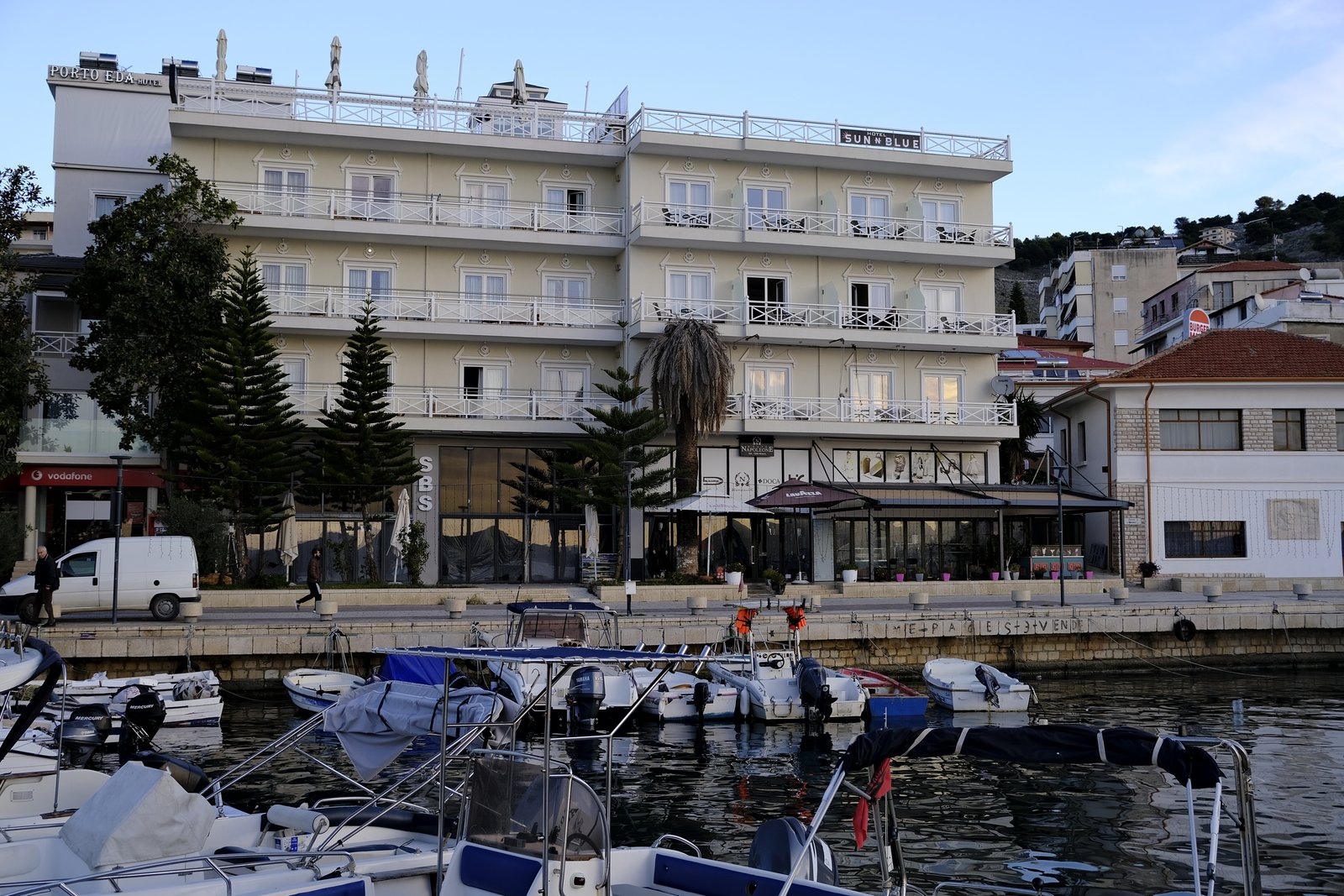
Start in Sarandë, which many visitors reach via the ferry from Corfu, a 35-minute crossing that has been operating in various forms since antiquity, and which deposits you directly into the Albanian Riviera with a pleasingly abrupt sense of arrival. Sarandë itself is a working coastal town that has discovered tourism with considerable enthusiasm in the past decade: the promenade is lively, the seafood restaurants are excellent, and the view across to Corfu on a clear evening is one of the more effortlessly beautiful things you will see in southern Europe.

Begin the day at Lëkurësi Castle, a 30-minute drive up the hill above town. The Ottoman-era fortification sits at the top of a wooded ridge with a panoramic sweep over Sarandë bay and the open Ionian Sea, with Corfu laid out like a dark-green carpet across the water. The castle itself is modest in scale; it is the view that justifies the ascent. Go in the late afternoon and you will understand immediately why this is one of the most photographed spots in southern Albania. The castle restaurant, operating inside the old walls, is also an entirely reasonable place to have a coffee while you absorb the fact that you have ended up somewhere this beautiful.
Ksamil, 14 kilometres south of Sarandë on a peninsula that juts into the Ionian, is the beaches. Four small islands just offshore, water in every shade of turquoise and aquamarine that the Mediterranean can produce, fine pale sand: Ksamil is the image that finally put Albanian beaches on Instagram, and it entirely deserves the attention. In July and August it is very busy; in May, June, September, or October it is busy but manageable, and the water is still warm enough to swim.
The non-negotiable afternoon is Butrint, 18 kilometres south of Sarandë, a UNESCO World Heritage Site and one of the most complete ancient cities in the world. Greek, Roman, Byzantine, Venetian: the layers pile up on this low peninsula ringed by lagoon water, all of it set inside a subtropical national park where you walk between ruins on forest paths with herons in the reeds and terrapins on every warm stone. Allow three hours minimum; the site is larger than you will expect. (We have written a full guide to Butrint separately; read it before you go.) Return to Sarandë for the evening: grilled fish on the promenade, and the koran trout if your restaurant has it, a species native to Lake Ohrid and a few connected waters that is genuinely unlike any trout you have eaten elsewhere.
Day 2 Morning: Blue Eye and the Mountain Road
Leave Sarandë early. Head east on the SH8. After about 25 kilometres, follow the signs for Syri i Kaltër, the Blue Eye. This will involve a short detour down a forest road, and then a short walk, and then you will turn a corner and see something that does not look like it belongs in the natural world.
Syri i Kaltër is a natural spring: water erupts from deep underground through a vent in the rock with such force and volume that the surface above it boils and churns. The depth is uncertain; divers have gone below 50 metres without reaching the bottom. Because of this depth and the optical properties of the water (which is crystal clear), the centre of the spring appears a vivid electric blue, not the pale blue of a swimming pool but a deep, saturated, almost supernatural blue, the blue of something that has never seen sunlight. Around it, rings of turquoise fade to green at the shallower edges. The temperature is a constant 10°C throughout the year, winter and summer, and when you crouch near the surface the cold comes off it in waves. The ancient beech and plane forest around the spring is silent except for birdsong. You will take approximately 400 photographs and all of them will be inadequate.
Back on the SH8 heading east, the road begins to climb. This is the best part of the drive. The mountains of the Gjirokastra region are spectacular: steep, heavily forested on their lower slopes, bare rock higher up, with deep valleys opening on either side and remote villages perched on ridgelines that look impossible to reach. The Muzina Pass, at the high point of the road, gives views back toward the coast on clear days: a last glimpse of the Ionian before the road descends into the interior. The road itself is well maintained and the curves are manageable, but it is a mountain road and the bends are tight. Take them at an appropriate speed and you will be fine. Take them at the speed of someone who has not noticed they are in the mountains and you will have an interesting conversation with a guardrail.
Optional Detour: Porto Palermo
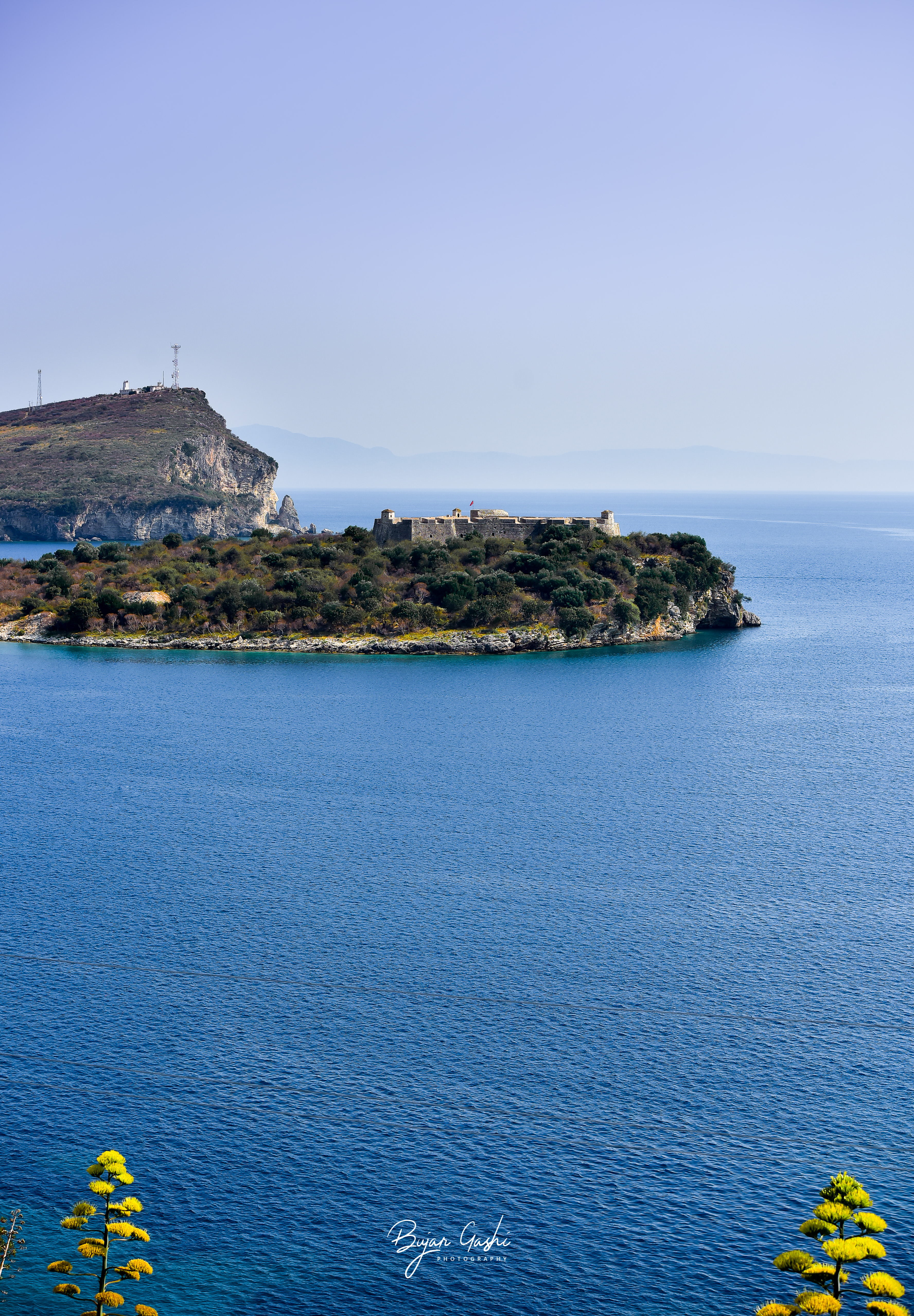
If you are approaching from the coast road rather than directly from Sarandë, or if you want to add an extra hour to the trip, the detour to Porto Palermo is worth it. The castle of Ali Pasha of Ioannina, the brilliant, brutal, semi-independent Ottoman warlord who controlled much of northern Greece and southern Albania in the early 19th century, sits on a tiny triangular peninsula in a perfect little bay, a three-towered fortification surrounded on three sides by the Ionian. Ali Pasha built it around 1810, and it was subsequently used by the communist regime as a submarine base, which gives it the peculiar distinction of being simultaneously a Napoleonic-era Ottoman fortification and a Cold War military facility. The exterior is accessible, the setting is gorgeous, and the combination of clear blue water and grey stone walls is entirely photogenic.
Day 2 Afternoon: Gjirokastër
Arrive in Gjirokastër in the early afternoon and go immediately to the old town (the bazaar, the castle, the lane that leads from one to the other) before you do anything else. The afternoon light on the grey-slate rooftops is something you want to catch while it is good.
The Old Bazaar of Gjirokastër is not a reconstruction or a tourist set; it is a functioning Ottoman-era trading district that has been open for business, more or less continuously, for five centuries. The craftsmen and traders have changed over the years (there are now more souvenir sellers and coffee shops than silversmiths and saddlers), but the stone arches, the proportions, and the particular atmosphere of a market town that has been doing this for a very long time are all entirely real. Walk slowly. Have a coffee. Watch the activity.
Gjirokastër Castle sits above everything, reached by a steep lane that will test your lungs but reward them with increasingly excellent views. The castle is one of the largest in the Balkans; it dates to at least the 12th century, was dramatically expanded by Ali Pasha of Ioannina in the early 19th, and houses an arms museum of moderate interest. What is not of moderate interest is the exhibit in the courtyard: a Lockheed T-33 reconnaissance aircraft, captured in 1957 when it strayed into Albanian airspace and was forced down. The plane sits there in the open air, surrounded by medieval stonework, with a faded red star on its tail, looking exactly as surreal as it is. It is possibly the most random museum exhibit in the Balkans, and the Balkans is not short of competition.
Waking up in a 19th-century Ottoman mansion in Gjirokastër, with the grey stone valley below and the mountains beyond, is a reasonable way to begin a morning. It is, in fact, an unreasonably good way to begin a morning.
Stay the night in Gjirokastër: the guesthouses in the old town are some of the best-value accommodation in Albania. Several operate out of genuinely historic Ottoman houses, with thick stone walls, wooden ceilings, and windows that frame the valley like paintings. Prices run €35–55 a night for a double, which is the kind of value that makes you look at your hotel bills from other European trips with renewed annoyance.
Practical Notes
A car is essential for this route. The Blue Eye is not accessible by public transport in any practical sense, and the mountain section of the SH8 is served by furgons (shared minibuses) that run when they are full and stop when something interesting happens, which may or may not align with your plans. Hire a car in Sarandë (several rental offices operate in the town) or arrange one from Tirana if you are arriving from the north. A standard hatchback is perfectly adequate for all roads on this route.
The SH8 is well maintained throughout. The mountain section has tight bends but is entirely manageable in a regular car. Drive at a relaxed pace and you will be fine. The only real hazard is other drivers who have confused the mountain road with a rally stage, and the standard Albanian defensive response to this, horn, patience, and brakes, in that order, is effective.
Timing: April through June and September through October are ideal. The weather is warm, the water is swimmable, and the crowds are manageable. July and August are hot and the coast is very busy, though Gjirokastër and the mountain interior remain relatively calm. Budget for the route: a good guesthouse in Gjirokastër costs €35–55; restaurant meals in both cities run €8–15 for a full dinner with wine. Butrint entry is around €6. This is not an expensive trip.