
Albania has two UNESCO World Heritage cities. They share a single inscription, awarded in 2005, with Berat's component extended in 2008, and they sit roughly a hundred kilometres apart in the country's rugged interior. Beyond these biographical coincidences, Berat and Gjirokastër could scarcely be more different. One is a city of white, sun-drenched houses cascading toward a river; the other is a fortress city of dark grey stone clinging to a mountain valley like something carved rather than built. Together, they represent Albania's most extraordinary contribution to European heritage, and two of the most underrated historic sites on the continent.
Berat: The City of a Thousand Windows
Berat sits at the confluence of the Osum River and the surrounding limestone mountains of central Albania, at a population of around 32,000. Its name in Albanian is Qyteti i Njëmijë Dritareve, the City of a Thousand Windows, and the reason is immediately apparent to anyone who approaches along the valley road. The hillside above the river is dense with tall white Ottoman-era houses, each one stacked above the next, their facades pierced by rows of enormous windows that catch and multiply the Balkan light. From across the Osum at the right time of day, the effect is almost incandescent: it is one of the most photographed views in the Balkans, and one of the few that entirely delivers on the photographs.
The city divides into three historic quarters, each with its own distinct character and religion. Mangalem, on the western bank of the Osum below the castle, is the old Muslim quarter: its timber-framed houses and winding lanes typical of Ottoman urban planning at its most accomplished. Across the river lies Gorica, the old Christian quarter, quieter and more contemplative, connected to Mangalem by an ancient stone bridge. And above them both, on the rocky bluff that dominates the skyline, is Kalaja, the castle itself, which has the remarkable distinction of still being inhabited. People live, keep gardens, and hang laundry out to dry within a Byzantine and Ottoman fortress.

Berat Castle, Kalaja, has Byzantine origins, though it has been expanded and rebuilt so many times over the centuries that it now represents a palimpsest of every power that has controlled central Albania. Within its walls, which enclose a remarkable village of their own, are nine active churches. The Church of the Holy Trinity dates to the 13th century; the Church of St Mary of Blachernae, incorporated into what is now the Onufri Museum, is arguably even more significant. Onufri was Albania's greatest Renaissance-era icon painter, working in the 16th century with a mastery that drew comparisons from contemporaries to the finest Byzantine and Italian artists of the age. His genius lay partly in technique (he developed an extraordinary crimson pigment of such intensity and durability that it has never been fully replicated) and partly in his ability to imbue the rigid conventions of Orthodox iconography with warmth and psychological depth. The museum dedicated to him, inside the castle precinct, holds the finest collection of his work anywhere.
The city's history stretches back far further than the Ottomans. Berat was known as Antipatrea under the Illyrians in the 6th century BC, and as Pulcheriopolis, Beautiful City, under Byzantine rule, a name that feels, on a clear morning with the thousand windows blazing in the sun, entirely deserved. It has been continuously inhabited ever since, making it one of the longest-occupied urban sites in the western Balkans.
The skyline of Berat from across the Osum, white mansions cascading down toward the water, is among the most compelling vistas in southeastern Europe, the kind of view that makes you understand immediately why UNESCO acts as it does.
Gjirokastër: The City of Stone
If Berat is all light and whiteness, Gjirokastër is its opposite: a city of shadow and weight, built from the same grey-blue slate that covers its rooftops, rises in its walls, and paves its steep lanes. It has been called the City of Stone so often that the epithet has lost something of its force; but stand in the old bazaar on a cloudy afternoon, surrounded by buildings whose every surface is the colour of rain, and you understand why no other name has ever stuck.
The city of around 20,000 people occupies a deep valley in the Drinos river basin, hemmed in by the Lunxhëria and Gjerë mountains on either side. Nothing about the site is easy: the terrain is steep, the winters cold, the logistics of building here were formidable. And yet the old town that grew here between the 17th and 19th centuries is one of the most coherent urban ensembles in the Balkans: a city that looks, from a distance, as if it has grown organically from the rock beneath it, which in a very real sense it has.
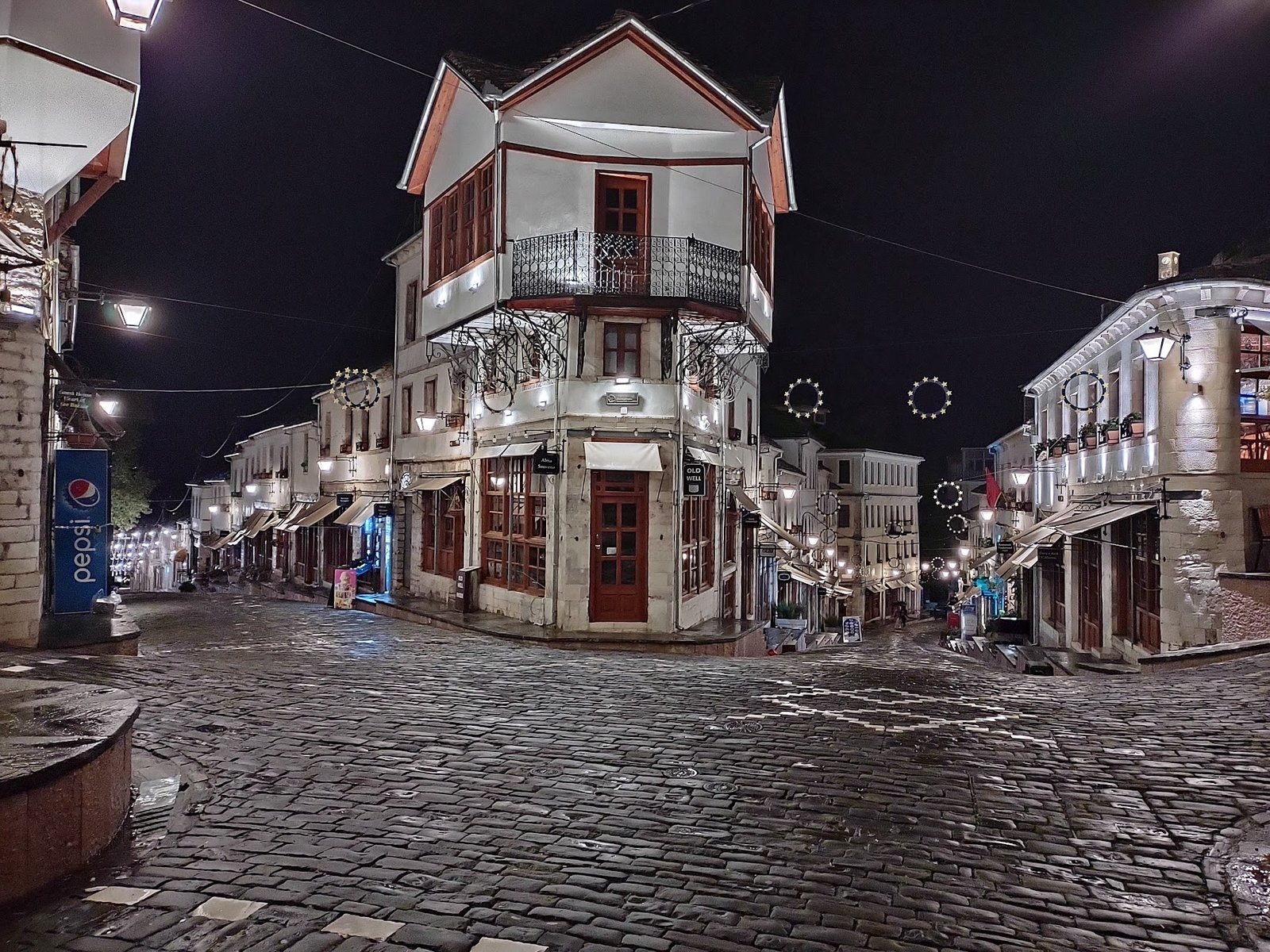
Gjirokastër Castle is one of the largest fortifications in the Balkans, dating in its earliest form to at least the 12th century and expanded dramatically by Ali Pasha of Ioannina, the remarkable Albanian-born Ottoman warlord who effectively governed a semi-autonomous fiefdom across northern Greece and southern Albania in the early 19th century. The castle houses an arms museum with a substantial collection of Ottoman and later weapons, and, uniquely, a US Air Force reconnaissance aircraft captured in 1957 when it strayed into Albanian airspace. The presence of an American jet inside a medieval Balkan fortress is exactly as surreal as it sounds, and it is one of the strangest museum exhibits in Europe.
The Zekate House, dating to 1811, is the finest preserved Ottoman mansion in Albania. Its double-vaulted tower, panoramic views across the valley, and meticulously detailed interior woodwork represent the domestic architecture of the Albanian bey class at its most refined. Walking through it is like stepping into a world that vanished with the Ottoman Empire; and it is remarkably, almost miraculously, intact.
Gjirokastër is also the birthplace of two of Albania's most significant 20th-century figures, whose legacies could not be more different. Enver Hoxha, the communist dictator who ruled Albania for 41 years and turned it into the most isolated nation in Europe, was born here in 1908. So was Ismail Kadare, Albania's greatest novelist, nominated repeatedly for the Nobel Prize, and one of the finest literary voices to emerge from Eastern Europe in the 20th century. The city holds both legacies with characteristic composure.
What the UNESCO Designation Actually Means
Both cities were significantly damaged during the communist era. The Hoxha regime pursued a policy of "modernisation" that, in architectural terms, meant the construction of concrete apartment blocks in and around historic centres, the conversion of religious buildings to secular use, and the deliberate neglect of Ottoman and earlier heritage, which was seen as ideologically compromised. By the time communism collapsed in 1991, followed by the chaos of the pyramid scheme crisis in 1997, both Berat and Gjirokastër had suffered decades of underinvestment and some irreversible losses.
The UNESCO inscription in 2005 was not simply an honour; it was a mechanism. International recognition brought with it access to funding, technical expertise, and, crucially, a framework of legal protection that had been entirely absent under communist planning. The Gjirokastra Foundation and parallel preservation efforts in Berat have since restored hundreds of buildings, repaved lanes, and stabilised structures that were in serious danger of collapse. The work is ongoing, underfunded relative to the scale of the task, and dependent on a combination of international donors, Albanian state commitment, and the dedication of local advocates who understand what is at stake.
The result, on the ground, is two historic cities that are genuinely alive: not preserved under glass, not turned into open-air museums, but inhabited, functioning, slowly recovering their dignity. They deserve to be as well known as Dubrovnik or Mostar. They are not, yet; and that, for the visitor who makes the journey, is precisely the point.