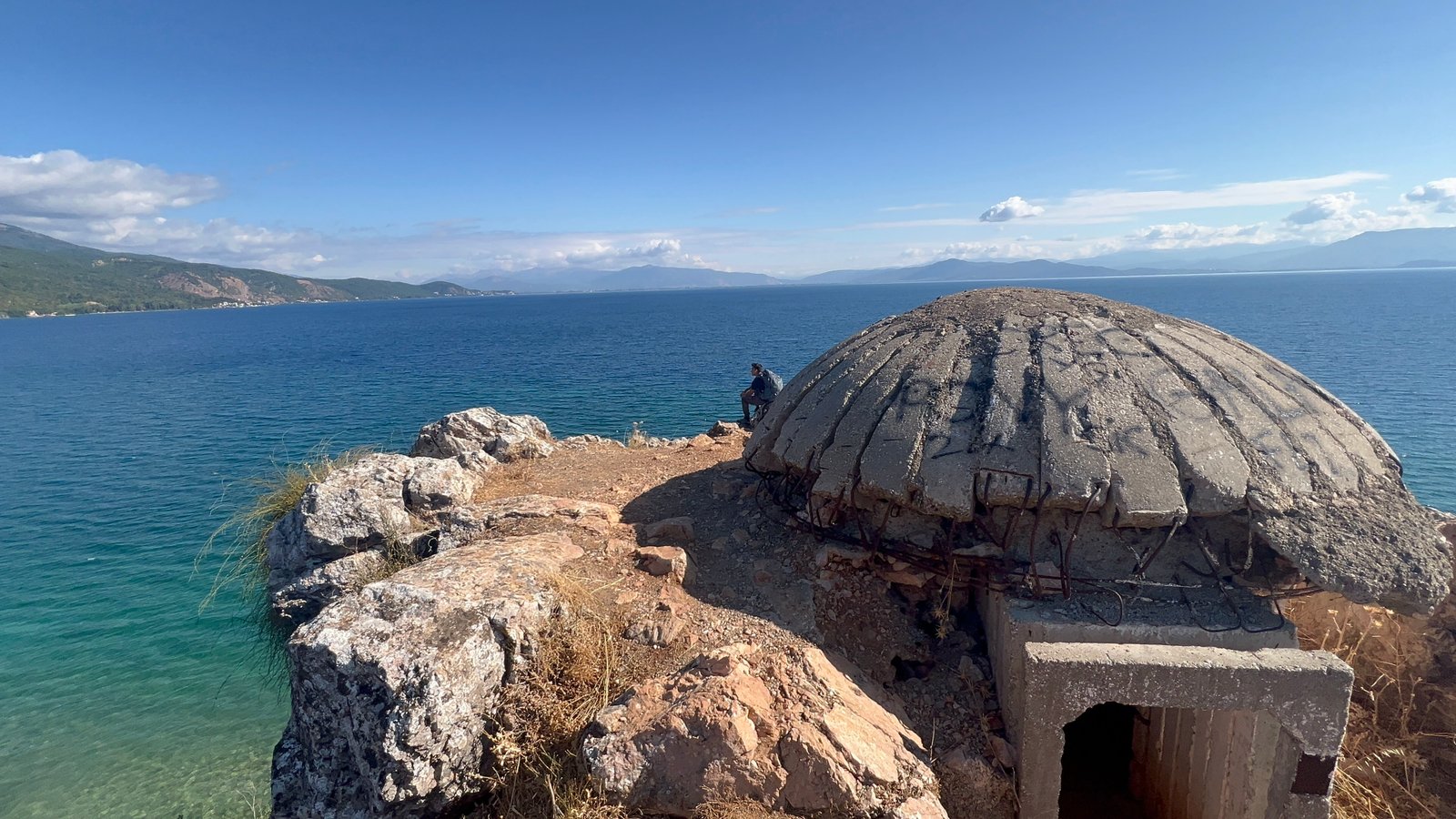
If you visit Albania and notice small grey mushroom-shaped concrete domes poking out of fields, hillsides, beaches, gardens, car parks, and the occasional traffic roundabout, you are not hallucinating. Those are bunkers. There are 173,000 of them. Albania built more bunkers per capita than any nation in history, at enormous cost to one of Europe's poorest populations, over the course of nearly two decades, and they never once fired a shot in anger. Not one. The entire enterprise was the architectural expression of a single man's extraordinary paranoia, executed in concrete durable enough to outlast the man, his regime, and quite possibly western civilisation as we currently understand it.
The Man Behind the Mushrooms
Enver Hoxha ruled Albania from 1944 until his death in 1985: 41 years, making him the longest-serving communist leader in the Eastern Bloc, a distinction he achieved through a combination of ruthlessness, ideological flexibility, and an absolute conviction that everyone was plotting against him. He was not wrong that some people were plotting against him. He was somewhat wrong about how many.
Hoxha's foreign policy record is a masterclass in the art of alienating your friends. He broke with Yugoslavia in 1948, on the grounds that Tito was a fascist stooge. He broke with the Soviet Union in 1961, on the grounds that Khrushchev was a revisionist traitor who had the temerity to criticise Stalin. He then allied with China, which seemed promising, until Mao died in 1976 and his successors turned out to be capitalist sellouts of the most brazen variety, prompting Albania to break with China in 1978 as well. By the late 1970s, Albania was the most isolated nation on earth. North Korea looked at it and felt mild concern for its wellbeing.
Having successfully placed itself in diplomatic opposition to Yugoslavia, the Soviet Union, the United States, Britain, NATO, the Warsaw Pact, China, and essentially the entire international community, Albania faced a question: who might invade? The answer, from Hoxha's perspective, was: everyone. The Greeks to the south had historical claims on northern Epirus. The Yugoslavs to the north and east had Soviet backing and bad intentions. The Americans and British were imperialist aggressors. The Soviets, post-1961, were revisionist aggressors, which is apparently worse. Someone was definitely coming. The only sensible response was concrete.
Building the Mushroom Army
Construction of the bunkers ran from 1967 to 1986. The standard design, the one you see in every Albanian field, every Albanian beach, and every third Albanian roundabout, is a low hemispherical dome, known colloquially as a qipollë (onion) or pillbox, with a narrow firing slit and a small chamber behind it just large enough to crouch in. They were built to withstand a tank driving directly over them, a claim that was tested: by an actual tank, with the engineer who designed them, Josif Zagali, sitting inside. The tank drove over. The bunker held. Zagali survived. The bunkers were approved for mass production with considerable enthusiasm.
Around 200,000 tonnes of concrete went into the programme: enough, by various estimates, to build a motorway the length of Albania several times over, or to provide every Albanian family with a comfortable concrete house, or to fund essentially any alternative use you might think of, all of which would have been more useful. The cost consumed a significant fraction of Albania's GDP for nearly two decades. Albania was already, by a considerable margin, the poorest country in Europe. The bunker programme made it considerably more so.

Durrës, Albania's main port city, has an estimated 6,000 bunkers along its beaches. Six thousand. On the beach. Imagine lying on a sun lounger, Mediterranean waves lapping at your feet, and being surrounded on all sides by 6,000 concrete onions, each one staring at the horizon through its little slit, waiting for an invasion that was never coming. The overall distribution is roughly one bunker for every four Albanians (men, women, children, and elderly included) which represents a level of defensive commitment that suggests either extraordinary national solidarity or extraordinary national terror, depending on your perspective.
The bunkers were built to protect Albania from everyone. They ended up protecting Albania from nothing. They are, arguably, the most expensive joke in European history, though it is the kind of joke that takes forty years to deliver the punchline.
The Bunkers That Never Fought
Hoxha died in April 1985. The communist system he built survived him by six years, remarkably, given the speed at which every other Eastern Bloc country dissolved, before finally collapsing in 1991. In all that time: not one foreign invasion. Not one tank that the bunkers needed to withstand. Not one firing slit that had to fire. The Greeks did not come. The Yugoslavs did not come. The Americans, the British, the Soviets, the NATO forces, the Warsaw Pact forces: nobody came. The 173,000 bunkers sat in their fields and on their beaches and in their gardens and watched the clouds go by.
The collapse of communism in 1991 was, in the Albanian case, extremely dramatic even by Eastern European standards, involving a mass exodus of 300,000 people to Italy in a single week, the toppling of Hoxha's giant statue in Skanderbeg Square, and a period of chaos that culminated in the 1997 pyramid scheme crisis, when approximately two-thirds of the country's population lost their savings simultaneously and the state effectively dissolved for several months. During all of this, Albanians had rather more pressing concerns than the bunkers. Many were looted for their steel rods, which are useful. The concrete shells were largely left alone, because reinforced concrete rated to withstand a tank is not easy to demolish with hand tools, and even the most motivated Albanian looting party had to draw a practical line somewhere.
What the Bunkers Are Today
Thirty-five years on from the end of communism, Albania has discovered something that every sensible nation eventually discovers about its architectural liabilities: if you cannot remove them, you might as well enjoy them. The repurposing of Albania's 173,000 bunkers has been creative, comprehensive, and deeply Albanian in its pragmatic ingenuity.
Beach bars and cafes are the most visible category: a bunker with a sea view turns out to be an excellent place to serve cold beer, and several have built thriving businesses on exactly this insight. Others have become storage sheds, garden features, children's dens, sheep shelters (the air circulation inside is, apparently, ideal), and in at least one documented case, a fully operational mushroom farm, which is architecturally appropriate in ways the original designers cannot have intended. Artists have adopted them as canvases; street art on bunkers has become a genre.
The highest expression of bunker repurposing is Bunk'Art 1: Enver Hoxha's personal nuclear bunker complex, built into a hill north of Tirana at a cost that would have made a reasonable person weep, and now one of the most extraordinary museums in the Balkans. The complex runs five storeys into the mountain, contains 106 rooms, and was designed to house the entire Albanian communist leadership during a nuclear war. It was never used. Today it hosts a permanent exhibition on the communist period, including the internal logic of Hoxha's increasingly unhinged foreign policy decisions, alongside changing contemporary art shows. Wandering its corridors, with their blast doors and spartan leadership quarters and meeting rooms where decisions of monumental stupidity were made in complete seriousness, is one of the most unsettling and fascinating experiences available in Albania.
Bunk'Art 2, in central Tirana, occupies a smaller bunker that served the Interior Ministry, which is to say, the secret police, the Sigurimi, the apparatus of surveillance and repression that watched over the Albanian population for decades. The exhibition there is considerably more sombre: it documents the methods and the victims, the show trials and the forced labour camps, the informer networks and the broken families. It is essential and it is difficult. Both museums together, the absurdity of the first, the horror of the second, give a complete picture of what the bunker programme actually was: not just a comedy of military over-engineering, but the physical expression of a state that was consuming itself with fear.
How Long Will They Last?
The Albanian government has been wrestling with the bunker question since 1991, which is now long enough that wrestling has begun to resemble acceptance. Demolition is prohibitively expensive: the bunkers were built to survive direct tank impact, and removing 173,000 of them would require industrial-scale effort sustained over generations. One estimate suggests that at current funding levels and demolition rates, clearing all the bunkers would take approximately 750 years. By which point, of course, they will be medieval ruins of considerable historic interest.
The emerging consensus, which has the virtue of both honesty and economics, is that the bunkers are simply part of Albania now: part of its landscape, part of its story, part of what makes it unlike anywhere else in Europe. A country that can transform 173,000 monuments to paranoid dictatorship into cafes, guesthouses, mushroom farms, and the occasion for a good deal of very dark national humour has probably processed its history better than most. The bunkers are not beautiful. They were not built for good reasons. But they are, undeniably, Albania's; and the Albanians, characteristically, have made something out of them.